Drupal

Drupal related posts by Gábor Hojtsy.

By Gábor Hojtsy , 9 February, 2015

I finally stopped putting it off and took the opportunity to test myself on the Acquia Certified Developer exam. To be honest I put it off for quite long. As a household name in the community I had fears it will prove I am not good enough and funnily enough, I did worst on back end development (ooops!) and 10% better on site building. My overall result is actually the same as Angie Byron at 85%. I'm flawless with fundamental web concepts at least. Ha!

As a computer science major who transferred into more of a mix of development, leadership, events and content production, I don't have much of an experience with tech certification exams. My only encounter was with the CIW certifications 13 or so years ago, which I took back in the day to be able to teach the CIW courses at a local private school. Judging from that experience and common wisdom, I expected paperbook style questions where I need to know the order and name of arguments and options on l() as well recite row styles of views and available options of date fields. The reality cannot be farther from that.

By Gábor Hojtsy , 27 January, 2015

Up to date as of October 29th, 2015.

In the introduction to content and configuration translation piece we discussed what is considered content in Drupal 8. This is a somewhat misleading term because custom blocks, custom menu items and even user entities (user profiles) are considered content in terms of their implementation.

Content is always stored as entities. The main difference between configuration and content entities is configuration is usually created on the backend (think views, vocabularies, etc.) while content is usually created on the frontend (think free tagging taxonomy terms, comments, blog posts). This is not a black and white differentiation but it helps think of the categories. The other key differentiator is content entities usually get to have configurable fields. You can add new fields to user profiles, taxonomy terms or comments. Again there are exceptions, for example custom menu items cannot get configurable fields in core. Finally, there are even content entities that will not be stored, in Drupal 8 contact form submissions are content entities that live only until they are sent via email. For this tidbit we are concerned for content entities that are stored and multilingual.

By Gábor Hojtsy , 6 January, 2015

Whew! 2014 was a fantastic year for the Drupal multilingual team. We had some great events with huge sprints, including but not limited to: Global Sprint Weekend, the amazing Drupal Dev Days Europe, NYC Camp, DrupalCon Austin, DrupalCon Amsterdam and BADCamp.

A fun fact about people on the multilingual team is that even though we usually turn out in big numbers at sprints, there are numerous great mentors among us, so we don't work on code that much at mentored sprints. We do a great job helping people get started and move into more serious core work though. Our most famous mentee this past year is 2014th Drupal 8 core contributor Holly Ross, Executive Director of the Drupal Association who contributed her first and second core patches fixing multilingual issues.

By Gábor Hojtsy , 12 December, 2014

Image

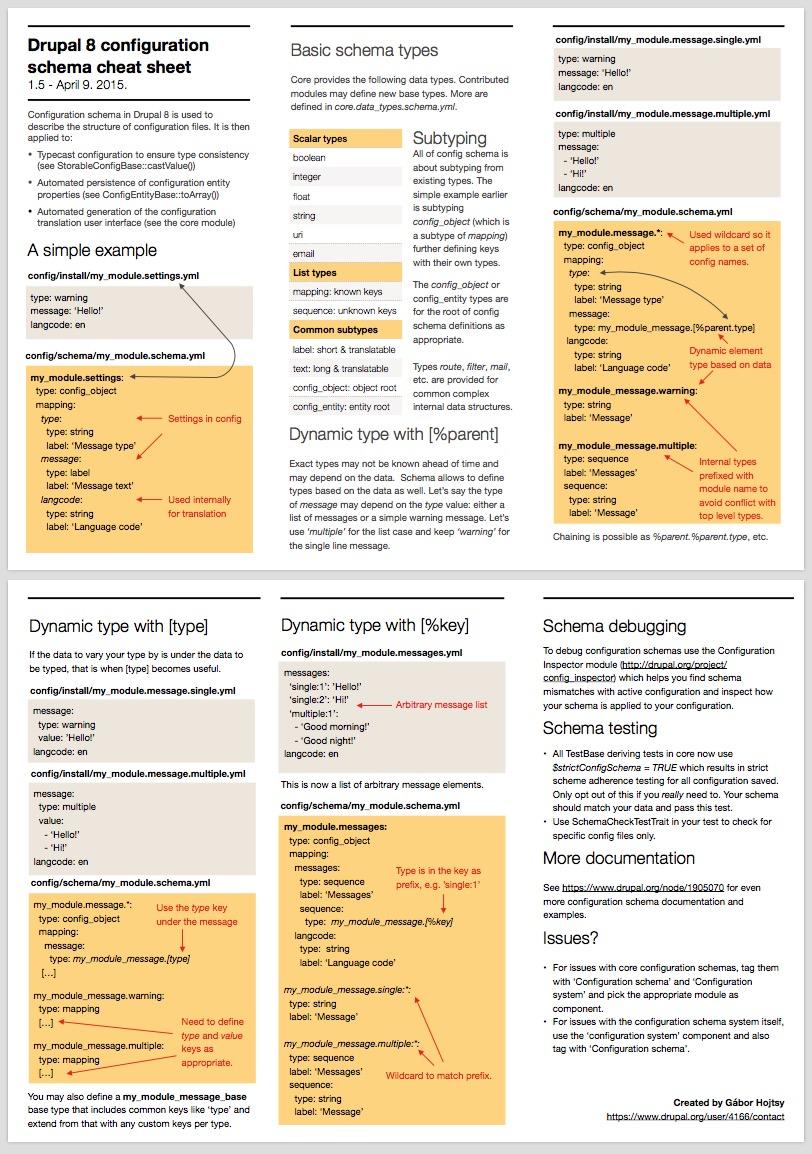
After over a month of concentrated work, Drupal 8 was ready today to finally flip the switch and enforce strict configuration schema adherence in all TestBase derived tests in core. See the announcement in the core group.

If you are a Drupal 8 contrib developer and provided some configuration schema earlier (or you integrate with an existing core system like blocks, views, fields, etc.) then your tests may now fail with configuration schema errors. Unless of course all your configuration schema is correct: #highfive for you then.

Otherwise I thought you'll have questions. There is of course the existing configuration schema documentation that I helped write. However if you are a visual person and want to get an understanding of the basics fast, I thought a cheat sheet would be a great tool. So sat down today and produced this one in the hopes it will help you all! Enjoy!

Please provide feedback for improvements in the comments, and I'll update the sheet as appropriate.

By Gábor Hojtsy , 17 October, 2014

I just had the time to watch Larry Garfield's DrupalCon Amsterdam core conversation on managing complexity today. I did not have the chance to attend his session live due to other obligations, but it is nonetheless a topic I am very interested in.

The key point of the talk in my understanding is the Drupal community needs to decouple and be component based (evolving around more independent components), so responsibility and authority is distributed and local. Larry specifically calls out that Drupal 8 initiative leads and component maintainers are "glorified secretaries" with responsibility but no explicitly granted authority.

I am not a native speaker and although I had an idea, I wanted to clear up what authority would mean. According to Google the power or right to give orders, make decisions, and enforce obedience. (I'll use hard power as a synonym). Larry alludes to parts of this definition in the talk with examples. While the talk is well worth the hour to get insights form one of the Drupal 8 initiative leads on some of the struggles we had in the Drupal 8 cycle so far, I think there are fundamental issues with the premise. The biggest fallacy is the gross generalisation and picking one facet out of a very multi-faceted situation, so the proposed solutions don't stand deeper scrutiny.

By Gábor Hojtsy , 18 August, 2014

Drupalaton 2014 was amazing. I got involved pretty late in the organization when we added sprinting capacity on all four days, but I must say doing that was well worth it. While the pre-planned schedule of the event focused on longer full day and half day workshops on business English, automation, rules, commerce, multilingual, etc. the sprint was thriving with backend developer luminaries such as Wim Leers, dawehner, fago, swentel, pfrennsen, dasjo as well as sizable frontend crew such as mortendk, lewisnyman, rteijeiro, emmamaria, etc. This setup allowed us to work on a very wide range of issues.

The list of 70+ issues we worked on shows our work on the drupal.org infrastructure, numerous frontend issues to clean up Drupal's markup, important performance problems, several release critical issues and significant work on all three non-postponed beta blockers at the time.

Image


Drupalers "shipped" from port to port; Photo by TCPhoto

Our coordinated timing with the TCDrupal sprints really helped in working on some of the same issues together. We successfully closed one of the beta blockers shortly after the sprint thanks to coordinated efforts between the two events.

Our list of issues also shows the success of the Rules training on the first day in bringing new people in to porting Rules components, as well as work on other important contributed modules: fixing issues with the Git deploy module's Drupal 8 port and work on the Drupal 8 version of CAPTCHA.

Thanks to the organizers, the sponsors of the event including the Drupal Association Community Cultivation Grants program for enabling us to have some of the most important Drupal developers work together on pressing issues, eat healthy and have fun on the way.

Ps. There is never a lack of opportunity to work with these amazing people. Several days of sprints are coming up around DrupalCon Amsterdam in a little over a month! The weekend sprint locations before/after the DrupalCon days are also really cool! See you there!

By Gábor Hojtsy , 14 August, 2014

DrupalCon Amsterdam is coming up in just a few weeks and it is full of opportunities to learn about and get all your questions answered when it comes to multilingual Drupal. What's better, you can get involved making things happen and learn from those implementing the features firsthand. Here are my picks:

Multilingual Drupal 8 site building and programming

Image
  • There is no excuse to not attend some of the sprints at and around DrupalCon. Sprints start two days ahead of the start of the conference on Saturday the week before. And there are still sprints going on the Sunday after the conference. It is not just the last day of DrupalCon itself where you can get involved and make a difference. In fact the leads are actually focusing more on the sprint on the weekend days. Also the weekend sprints are in a really cool venue. The best way to learn is to do!
  • You are looking for more of a directed guide of Drupal 8 still with the possibility to do it all hands-on? Look no further than the Drupal 8 multilingual hands-on lab presented by Aimee Degnan of Hook42 and myself from Acquia. The schedule info is a bit misleading, this session spans two timeslots and lasts two hours. Bring your laptop with Drupal 8 freshly installed!
  • Dive deeper into the APIs of Drupal 8! Francesco Placella from Tag1 presents Multilingual Content in D8: a Highly Evolved Permutated API showing how to code with the new system. While not strictly multilingual, in Field API is dead. Long live Entity Field API! swentel, yched and amateescu show how the most essential content element storage system changed and this is full of multilingual support of course.

Multilingual Drupal 7 site building and programming

Moving localize.drupal.org forward

The localize.drupal.org site seriously needs people who care about it enough to devote time to maintaining and fixing bugs. I set up one more BoF to gather people interesting in the well-being of this site titled We love localize.drupal.org. We need to upgrade to Drupal 7, support the whole range of new Drupal 8 APIs, drastically improve performance and then get new features going.


These are all the multilingual pieces that I collected. There may still be more, BoF scheduling just started and I may have missed a session or two. Let us know in the comments what other great events happen around multilingual Drupal. See you in Amsterdam!

By Gábor Hojtsy , 24 June, 2014

Drupal.org provides an amazingly flexible issue queue and is the backbone of most community activity around code, community, policies, drupal.org itself and so on. Each issue has a priority value which can be one of Critical, Major, Normal and Minor. Even more interesting is the tagging system we use with some commonly used tags like 'beta blocker' or 'beta target' or 'revisit before release' which add extra priority on top of the single value field. The drupal.org issues however don't lend themselves to supporting working on your priorities. Here are some options and tools I used so far that help solve this issue.

By Gábor Hojtsy , 26 May, 2014

Up to date as of October 29th, 2015.

We learned how configuration translation works on the conceptual level and through the Drupal 8 built-in user interfaces in the previous article of the series. In this article, we'll cover how can developers integrate with configuration translation.

Explaining the structure of configuration

We used your main site configuration file as an example in the previous article. Let's review that again (system.site.yml):

uuid: ''
name: ''
mail: ''
slogan: ''
page:
  403: ''
  404: ''
  front: /user/login
admin_compact_mode: false
weight_select_max: 100
langcode: en
default_langcode: en

There are clearly some translatable elements here. Which ones? Well, at least the site name and slogan would be. How would Drupal know though? There is nothing in this file to tell Drupal about that. There is also no code in handling this configuration that needs to deal with that. We wanted to introduce language support in the most transparent way. Instead Drupal supports a static description format to describe the structure of configuration, that we call configuration schema.

By Gábor Hojtsy , 19 May, 2014

Up to date as of October 29th, 2015.

After a long 8 months break in the article series, we are back to talk about configuration translation basics. Why the long break? Well, both the configuration and content system was in heavy development with changes and I did not want to get you content that would be quickly outdated. In the meantime Alex Pott also posted a great set of articles titled Principles of Configuration Management Part 1 and Part 2 which serves as great introductions. We’ll cover configuration translation first because that is more baked.

The Drupal 8 configuration system is a boon for language

As I wrote in the previous article in the series, configuration is now encompassing lots of settings that were variables or used custom settings storage in Drupal 7. The biggest value for non-English and multilingual sites in Drupal 8 of the configuration changes is that now a common system is used to manage your site name, email text settings through to views, field settings, entity form displays, etc. We can introduce language and translation support in a way that modules will need to plan with. It is not just an optional contributed add-on but a core feature.