Drupal

Drupal related posts by Gábor Hojtsy.

By Gábor Hojtsy , 2 July, 2013

Up to date as of October 16th, 2015.

One of the strongly supported language features of Drupal is right to left (RTL) language support. For some Drupal core versions, introducing an RTL language on the site is easy. Language settings include the choice of left to right and right to left orientation per language. This is still the same in Drupal 8.

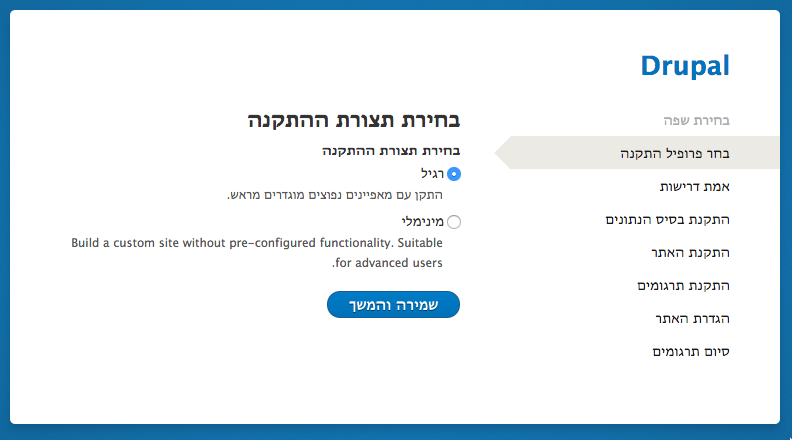
There are two notable improvements though. Language settings being at the front of the installer, we have clean support for right to left orientation from picking the install profile even:

Image

Also, Drupal 6 and 7 had a special solution for writing right to left CSS. For any CSS file in the system (file.css), you could have an RTL counterpart (file-rtl.css) that was automatically added to the page when needed. This was a Drupalism and browsers got much better at supporting attribute selectors in the past years, so now the right to left CSS is all integrated in the actual CSS files. You should now use attribute selectors such as [dir="rtl"] to target specific parts of the CSS at RTL displays. By keeping the right to left styles close to the base CSS, there is less chance for mistakes and missing or out of sync RTL styling, so we hope this will result in even better RTL support!

See https://drupal.org/node/2032405 for more information and code examples.

Issues to work on

  • DONE! Ok, ok, I cheated a bit with the above screenshot. There is still a bug with the sidebar position of the installer in RTL. See https://drupal.org/node/2033137 - should be an easy one to fix though
  • One more thing that you may notice on the screenshot is that even English text got the RTL treatment in terms of the placement of the end of sentence period. This is not a very easy problem to resolve. An issue is going for over two years at https://drupal.org/node/1165476 to resolve this by printing additional language and direction information in this case, so the browser knows which parts are not in the (RTL) language requested. This would be useful for left to right settings also to mark the language of parts that are untranslated. Creative ideas welcome!
  • There still may be missing RTL styles, especially on the administration interface. See https://www.drupal.org/node/2359331 for a collection of issues dealing with the situation.
By Gábor Hojtsy , 21 June, 2013

Up to date as of October 16th, 2015

As we touched on in the detection options tidbit and when talking about language configuration, the site default language used to be a very key (and higly dangerous to change) setting, because all the things that were in an unspecified language were assumed to be in that language. In Drupal 8, one of our most important goals was to make everything know its language as far and wide as possible.

Extensible special languages

Not everything can have a language even if it has a language property. Drupal 7 has one special language, Language neutral for these cases. This "language" is assigned to content which is not specifically in a language. People also used this to designate when the language was not known but some language needed to be assigned later. In Drupal 8, these two roles are separated into "Not applicable" and "Not specified" respectively. Also, these two special languages are stored as configuration with the other administrator configured languages (but are not shown on the configuration page to avoid confusion). Modules and distributions can add more special languages like these easily. These are locked (cannot be edited or removed), and when shown in a language list, they show after the manually configurable languages.

By Gábor Hojtsy , 19 June, 2013

Up to date as of October 16th, 2015.

Once/if you have multiple languages configured on your website, selecting from them for the page becomes an important question. The Drupal 8 language detection and selection options are located the same place they were in Drupal 7 but almost all options got some improvement.

Useful out of the box

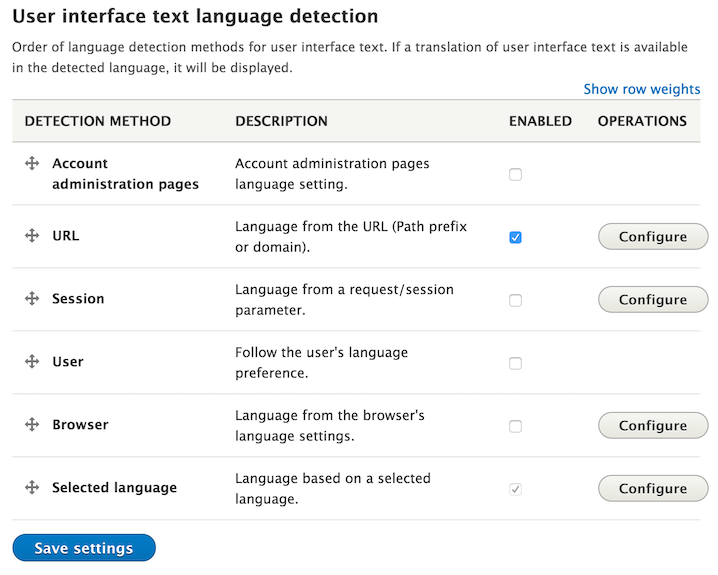
Drupal 7 only had the default language detection method turned on, so even if you kept adding in more and more languages (and even if you enabled the language switcher block), the URLs did not work. You still needed to get here and configure the URL detection method. Now this is built-in, so adding languages and placing a selector block would in itself make multiple languages accessible.

Image
By Gábor Hojtsy , 17 June, 2013

Up to date as of October 16th, 2015.

As I've outlined in the previous post Drupal 8 core now has 4 core modules to deal with language support. This tidbit will be about the simple language setup features provided by Language module, which is the base for every other language feature.

Image

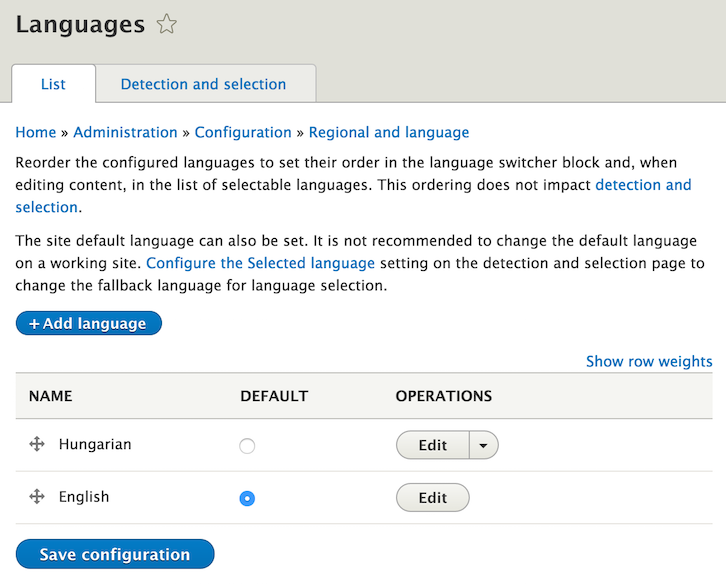
Language module provides a simple language overview screen. You can reorder existing languages, remove languages (except the site default language, which on the screenshot is English) and add new languages. It is not anymore possible to have enabled and disabled languages on your site. This feature resulted in a confusing mess where some places and permission combinations allowed for the use of disabled languages and it was used as a means to stage certain new content. Just use proven content staging techniques (or unpublished posts) for new language content.

By Gábor Hojtsy , 12 June, 2013

Up to date as of October 16th, 2015.

Once you install Drupal 8 in a foreign language, you'll have Language and Interface translation modules enabled with the chosen language configured. Drupal 8 has more core modules handling language related features, yet less requirement for contributed modules to be installed for the most important tasks (on my last count, the 4 modules explained here cover functionality of 20+ modules from Drupal 7 and in much better ways).

Why have multiple modules when a multilingual site just needs all the features? Well, there are also foreign language (not multilingual) sites that we aim to support better and multilingual sites can be very different as well. Also, admittedly there are technological reasons to organize the modules by the features they provide.

In Drupal 8 multilingual is one of the groups of core modules, so you'll find these modules under the main core modules in a neat group.

Image
By Gábor Hojtsy , 11 June, 2013

Up to date as of October 16th, 2015.

Starting a new series

The Drupal 8 Multilingual Initiative was announced on May 9th, 2011. Since it's inception, the heroic efforts of people on the initiative resulted in hundreds of issues resolved but there are always more to perfect. We have made huge advances in terms of multilingual support in Drupal 8 thanks to all these changes and you can still help to make it perfect.

I'd love to highlight some of the great improvements that we made to make you excited about what is coming and point out some related places where you can still help to perfect what we have so far. This is number one in a series of short posts to discuss these improvements.

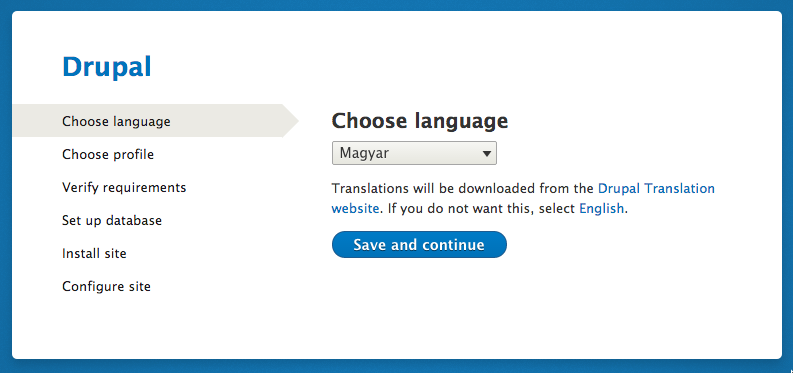
Language first in the installer

Drupal 8 makes language occupy the prominent first step in the installer. And compared to Drupal 7 where you were presented with a wall of textual instructions as to how to locate and download a translation file, place into a specific directory and reload the page, Drupal 8 comes with the realization that these are all tasks we can automate. So we show you about a 100 languages to choose from to install Drupal 8 in.

Image

The new Drupal version also comes with highly improved browser based language detection capabilities, so it will attempt to automatically identify your preferred language for this installation based on what your browser tells us. So in most cases, you'll likely just hit the button to continue and not think much about this.

We not only present you with the list of languages, we also download and import the translations to your system proper. So all the steps you did manually before are now automated. The installer can also fully show up in right to left languages.

Image

Also, if you pick a foreign language here, English will not be among your site's languages anymore either. Drupal 8's assumption is that if you install in a foreign language, you likely want a foreign language website without English showing up at all kinds of places as an option. Compared to Drupal 7 where English was not possible to remove.

By Gábor Hojtsy , 30 May, 2013

I've had the pleasure to present the current state of the Drupal 8 Multilingual Initiative - great work of numerous highly respected individuals - just last week in Portland at DrupalCon Portland 2013. Although I did do live demos at previous editions of this session, at this point we have just too many great improvements, that it does not fit anymore. So for this session, I opted to provide a better overview and more context as to how this affects site building in general for Drupal 8, including the extent of change as it applies to contributed modules.

We are still working on several key pieces of the initiative, and will have meetings every Wednesday leading up to the code freeze coming July 1st, 2013. Join on our meetings to help with the remaining tasks. We have tasks for all experience levels!

Download the slides from https://portland2013.drupal.org/sites/default/files/slides/D8MI-Portlan…

By Gábor Hojtsy , 7 February, 2013

Many of the Drupal 8 core APIs are shaping up now, and as Larry Garfield likes to say "we are still not ready porting Drupal 8 to Drupal 8". Meaning that the new APIs introduced are not used widely at all places where they would be applicable. Views is in core, but not all listings are views, router configuration instead of menu hooks are in core, but most modules use menu hooks, and so on. We of course target the final Drupal 8.0 release to have these conversions done, but we need more help to do them. Let me highlight items that interest me most as the multilingual initiative lead (but most of these rhyme with multi-channel publishing / web-services efforts as well).

Help convert content-like things to content entities

Drupal 8 has a new improved Entity API to manage content entities. What better opportunity to get to know the new content handling APIs than being involved in porting core components to it? Web services and multilingual are both fundamentally in need of a unified handling for content-like stuff in Drupal.

Comments have already been converted to the new entity API (http://drupal.org/node/1778178) which can serve as an example for conversions elsewhere, namely nodes (http://drupal.org/node/1818556), users (http://drupal.org/node/1818570) and so on. See the full list of conversion issues at http://drupal.org/node/1818580. Once these conversions are done, we still need to apply multilingual property handling to do such basic things as editing titles on nodes in different languages (http://drupal.org/node/1498674).

While the existing entity types need conversions, there are also other content-like things in core that need to be converted to entities proper. For example aggregator feeds (http://drupal.org/node/293318) have been converted to content entities but more needs to be worked on. Hands are needed to help with converting menu links (http://drupal.org/node/916388) and custom blocks (http://drupal.org/node/1871772) as well.

Learn Drupal 8 configuration by porting things to the configuration system

The new configuration system in Drupal 8 is great in unifying all configuration elements under one system instead of custom one-off database storages and APIs for configuration.

There is a laundry list of system settings forms to convert to configuration at http://drupal.org/node/1696224 including locale module settings, file system settings, etc. still to be done.

Drupal 8 also comes with configuration entities, which store their data with the configuration system (and are not fieldable). Some of the previously custom coded features such as views, menus (http://drupal.org/node/1814916) and contact form categories (http://drupal.org/node/1588422) have been converted to configuration entities. Others like languages are still to be done (http://drupal.org/node/1754246). Track all related issues at http://drupal.org/node/1802750.

Learn the new configuration schema system by writing schemas for configuration

A configuration schema system was just recently added to core (see http://drupal.org/node/1905070 for documentation and examples). Some configuration files got a schema defined in the initial patch, but there is still more work to be done to adopt this and complete. For example, only some of Views got schemas written, and we need to complete that (http://drupal.org/node/1910606). The meta issue to track and find schema issues is at http://drupal.org/node/1910624.

Why get involved?

I think this is a unique opportunity to (a) get to know Drupal 8 early (b) still have a chance to shape things in Drupal 8 where you find them confusing (instead of bragging about them too late when there is no chance to change) and (c) help Drupal 8 become the great consistent platform we all want it to become. Better web services features and dramatically more extensive multilingual features are also a huge plus!

How to get help if you get stuck?

Most of these issues have someone who got it started and you can find the people who worked on previous complete conversions that I linked to above. Find these people on IRC, get involved in virtual meetings, ask at core mentoring hours. Sometimes all is needed is reviews, help testing or help writing tests.

Thanks for all your contributions!
By Gábor Hojtsy , 28 November, 2012

I've had the pleasure to present the results of the Drupal 8 Multilingual Initiative - great work of numerous highly respected individuals - at the start of this month in Berkeley at BADCamp 2012. The session has some great demo content about where did we get and background information on what is still to be done. We are pretty close with all the essentials but will not be bored for the rest of the Drupal 8 release cycle either to put on more polish and fix the rough edges. Meet us this Friday, the last day before the Drupal 8 feature freeze if you want to get involved!

By Gábor Hojtsy , 13 July, 2012

The content translation problem

One of the great goals of the Drupal 8 Multilingual Initiative (D8MI for short) is to have one unified system for content translation. The basic problem is that with Drupal 7, you have two ways to translate content: copy nodes for different language versions (with the built-in Content translation module) or save different languages under one entity (with the built-in multilingual fields capability). Although the later does not have a user interface in core, the API is there, so well respecting contributed modules need to support both. The reality is that many modules support neither, because node copies are combersome and field language support is painful.

This is both a user and a developer problem. Users need to decide their translation methods up front, and both methods have their advantages and limitations. Node copies allow for best workflow because they have authors, publication status, permissions, core search support, etc. all a given. Field language on the other hand works better with relations (when signing up for nodes, putting nodes into a common menu, etc.) as well as sharing values between translations (product images, non-translated attributes, etc.). The grand plan for Drupal 8 is to figure out a way for a system that marries the advantages of all as possible and have one better configurable system instead of two independent systems. This should make it easier for users and developers alike to work with multilingual entities.

This is an extremely simple idea, yet the implementation is lagging behind enourmously.